How to play pickleball: a beginner's guide
The kit you need, the shots to learn first, where to stand and how to find a game in the UK. For the serve, the two-bounce rule, the kitchen and scoring, see our pickleball rules guide.
Pickleball in 30 seconds
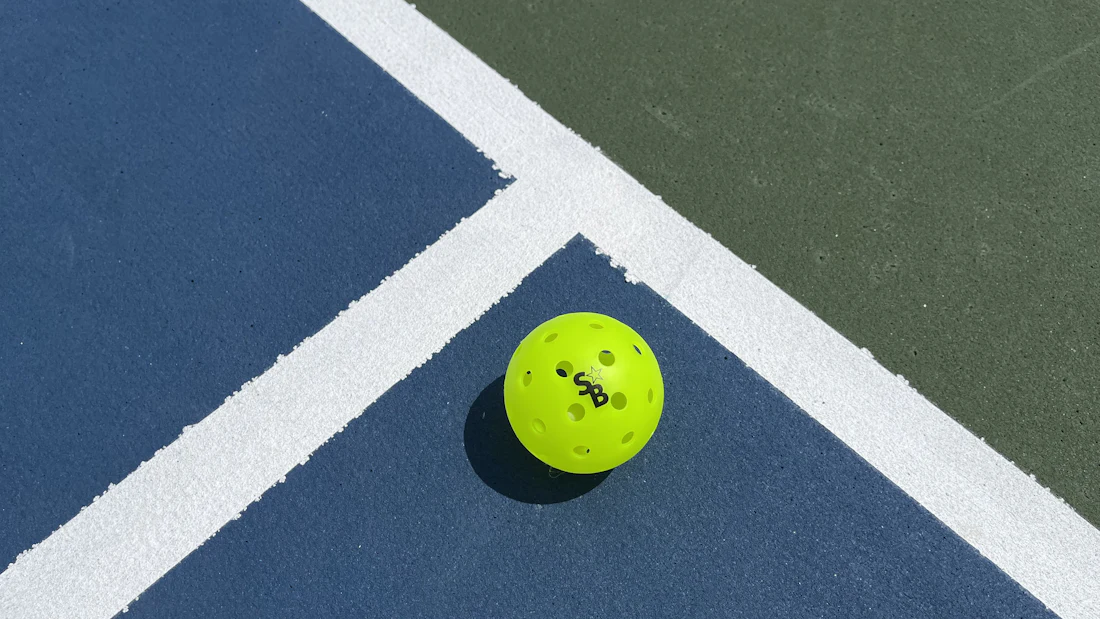
Pickleball is played with solid paddles and a plastic ball with holes, on a court about a third the size of a tennis court, usually in doubles. You serve underarm, the ball must bounce once on each side before anyone volleys, and you can't volley from the area next to the net, called the kitchen. More in what is pickleball.
What kit you need
Just a paddle and a ball. Many venues have kit you can borrow, and Better leisure centres provide it at their drop-in and social sessions.
| Kit | What to know |
|---|---|
| Paddle | The LTA calls a midweight paddle (205 to 240 g) the best choice for beginners. A thicker core gives more control. Our picks: best pickleball paddles. |
| Balls | Outdoor balls are harder, with more, smaller holes (typically around 40) to cope with wind. Indoor balls are softer, with fewer, larger holes (typically around 26). Use the one that matches where you play. |
| Shoes | Trainers or tennis shoes. Avoid running shoes: they aren't built for side-to-side movement, and rough courts wear their soles quickly. |
| Clothing | Any comfortable sportswear. |
The shots
Learn these first
- Serve: starts every rally. Keep it simple and consistent rather than powerful or close to the lines.
- Return of serve: hit it deep, so you have time to move up to the kitchen line.
- Dink: a very soft shot from at or near the kitchen line that just clears the net and lands in your opponents' kitchen.
- Volley: any shot hit before the ball bounces. You can't volley while standing in the kitchen.
Then these
- Third-shot drop: the serving team's soft, arcing third shot into the opponents' kitchen. They can't attack it, which gives you time to move forward. Pickleball England calls it the most important shot to master.
- Drive: a hard, flat shot. Use it as a tool, not on every ball.
- Lob: a high ball over your opponents' heads that pushes them back. Too short gets smashed, too long goes out.
- Overhead smash: for when your opponent pops the ball up. Hit down and go for accuracy over power.
There's no official learning order. This one follows USA Pickleball's beginner tips, which put consistent serves, deep returns and dinking first, and treat the third shot as a more advanced skill.
Where to stand in doubles
- Get to the kitchen line: most points are won there, so move up as soon as you can.
- Mind the two-bounce rule: after the serve, both servers stay back until the return has bounced. On the receiving side, the receiver starts at the back and their partner starts at the kitchen line.
- Move as a pair: stay about 2 to 2.5 m apart and move together, so you don't leave gaps.
- Don't hang around mid-court: between the baseline and the kitchen line, opponents can hit at your feet.
- The middle: balls down the middle cause hesitation, so call "mine" or "yours". A common default is that whoever has the forehand in the middle takes it, but agree with your partner first.
- Be ready: paddle up around chest height, knees bent, short backswing.
Common beginner mistakes
- Staying back at the baseline instead of moving up to the kitchen line.
- Hitting too hard. Placement and consistency win more points, and big swings cause pop-ups.
- Rushing the net straight after serving and forgetting the two-bounce rule.
- Standing flat-footed with the paddle down.
- Holding the paddle too deep in your palm.
- Rushing the serve and taking your eye off the ball.
- Trying spin and advanced shots too early.
Etiquette
- Call the score clearly before every serve. In doubles it's three numbers; see the rules.
- Line calls: in social play you call the lines on your own side. If you're not sure a ball was out, it's in.
- Call your own kitchen faults.
- "Ball on": if a stray ball rolls onto your court, shout "ball on" and stop the point. Don't chase your own ball onto another court mid-rally.
- Paddle tap: meet at the net after the game and tap paddles gently.
- Open play: many sessions use a paddle rack. Put your paddle in the queue and the next four paddles take the next free court. Formats vary, so ask how it works locally.
- Don't coach unless someone asks.
How to find your first game in the UK
- Find a club: Pickleball England's club locator now runs on PickleBook. Pickleball England suggests calling a nearby club to arrange a taster session.
- Try a leisure centre: Better runs beginners' drop-in and social sessions with kit provided, open to non-members.
- Ask your local tennis club: the LTA suggests checking whether your nearest tennis venue offers pickleball.
- Book a course or a coach: some venues run beginner courses, and Pickleball England has a find a coach directory.
FAQ
Is pickleball easy to learn?
It's designed to be: the court is small, the serve is underarm and the ball is slow. The kitchen and two-bounce rules take a few games to get used to.
Can you play pickleball on a tennis court?
Yes. The LTA says tennis courts can be converted temporarily, and some tennis clubs now run pickleball sessions.
Padel or pickleball?
Both are quick to learn, but they're very different games. See padel vs pickleball.
- LTA: pickleball equipment guide and how to get started
- Pickleball England: what is pickleball, strokes and shots and PickleBook
- USA Pickleball: tips for new players, positioning tips and doubles strategy
- USA Pickleball: rules summary
- Selkirk: the unwritten rules of pickleball, beginner mistakes and the paddle rack
- Pickleheads: beginner mistakes and doubles rules
- Better: pickleball
Last checked: 1 November 2026